
OUR METHOD
Pilates is not one-size-fits-all — and it was never meant to be.
At Selah, we teach Pilates as a complete, integrated system, designed to build strength, improve mobility, support posture, and help you move with greater confidence and awareness in everyday life. Rather than focusing on trends or quick results, our approach is rooted in quality, progression, and purposeful movement.
Whether you’re working on the mat, on the reformer, or using the full Pilates apparatus, each element plays a distinct role in supporting your body and your practice.
What Makes Pilates Different?
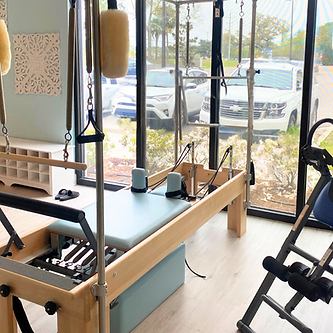.png)
The Pilates Method is a full-body movement system developed by Joseph Pilates, built on the belief that physical and mental health are deeply connected. Rather than focusing on isolated muscles or quick results, Pilates trains the body to move with control, efficiency, and balance.
At its core, the Pilates Method is about how you move, not how much you do.
Every exercise is designed to improve strength, mobility, posture, and coordination while encouraging awareness, breath control, and intentional movement.
The Pilates Method focuses on:
-
Whole-body integration rather than isolated muscle work
-
Quality of movement over quantity
-
Strength with mobility and control
-
Long-term body health, not short-term intensity
This makes Pilates suitable for a wide range of people — from beginners to athletes, from those managing injuries (with clearance) to clients simply wanting to move better in daily life.

The Principles Behind the Pilates Method
While Pilates includes a wide range of exercises and equipment, the method is unified by a set of guiding principles that shape every class.
These include:
-
Control – moving with intention and precision
-
Alignment – organising the body for efficient movement
-
Breath – supporting movement, focus, and control
-
Concentration – bringing awareness to every exercise
-
Flow – creating smooth, connected movement
-
Precision – performing each exercise with care and purpose
Together, these principles create movement that is both challenging and intelligent, strengthening the body while respecting its limits.

Classical vs Contemporary Pilates
Pilates has evolved over time, resulting in two main approaches:
Classical Pilates and Contemporary Pilates.
Both are rooted in the original work of Joseph Pilates, and both offer powerful benefits when taught with integrity.
Classical Pilates follows the original exercise order, structure, and apparatus as closely as possible. It emphasises:
-
The traditional repertoire
-
Consistent sequencing
-
Flow, rhythm, and discipline
Contemporary Pilates builds on the original method while incorporating modern movement science, biomechanics, and rehabilitation principles. It allows for:
-
Exercise modifications
-
Injury-aware programming
-
Adaptations for different bodies and life stages
At our studio, we don’t believe in choosing one over the other.
We embrace both Classical and Contemporary Pilates, blending respect for the original method with intelligent, modern application. This allows us to meet each client where they are — while still honouring the depth, intention, and intelligence of Pilates as a system.